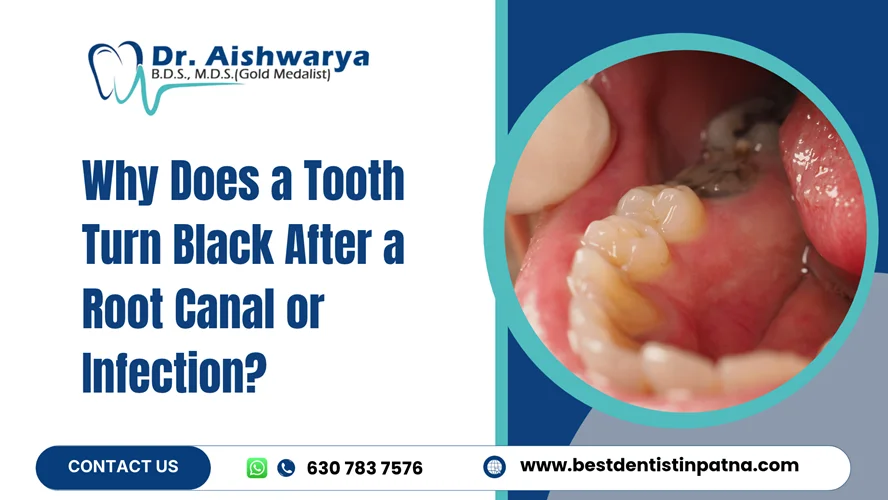
Notice that one of your teeth is turning grey, brown or black after your root canal treatment or after you had been suffering from a dental infection. Is this normal? Did you damage the tooth or is there another problem waiting to be detected by your dentist?
Tooth discoloration can occur due to internal staining or damage to the remaining pulp tissue. It may also result from blood breakdown products following an infection or the use of certain dental materials and techniques.
In some cases, discoloration can indicate an underlying dental problem that requires professional attention.
By understanding why your tooth has discolored following root canal treatment or a dental infection you can address any underlying problems with your teeth.
Why Does a Tooth Turn Black After Root Canal Treatment?
The root canal treatment in Patna includes the removal of the infected or damaged pulp in the tooth, the cleaning of the root canals and their closure in order to prevent new infections.
While endodontic treatment saves a natural tooth, root canal-treated teeth can change color and become darker over time.
Common reasons include:
Breakdown of Blood Products
When a tooth’s blood vessels are damaged (either due to infection or trauma), the blood in these vessels may break down and release certain pigments (e.g., hemin) from the blood components.
These pigments leak out of the damaged vessels and seep down into the dentinal tubules where they can cause tooth discolouration to vary from grey to brown to black.
Remaining Pulp Tissue
When pulp tissue remains inside a tooth and gradually breaks down, it can cause internal staining. Over time, this process may lead to noticeable tooth discoloration, often making the affected tooth appear darker than the surrounding teeth.
Dental Materials
Certain dental materials and root canal sealers can cause tooth discoloration over time. The severity of staining often depends on how close the filling material is to the visible crown of the tooth. Materials extending towards the crown may result in more noticeable discoloration.
Changes in Tooth Structure
After root canal treatment, a tooth no longer contains living pulp tissue. However, changes in the tooth’s internal structure and possible previous damage can lead to discolouration of a tooth.
If your tooth darkens after root canal treatment, consult a dentist to identify the cause and explore suitable treatment options.
Can a Dental Infection Cause a Tooth to Turn Black?
Dental infections can cause tooth discolouration, usually when an infection in the dental pulp is present and caused by bacteria.
Pulp necrosis is a state of inner tooth death, caused by deep decay, dental trauma, internal tooth discolouration or an untreated tooth infection.
Some common causes include:
- Deep tooth decay: This is usually caused by an untreated tooth decay.
- Dental trauma: A sudden injury to the mouth, either through an accident or by mistake, can disrupt the blood supply to a tooth.
- Pulp necrosis: Dead pulp tissue discoloring the inside of the tooth.
- Untreated infection: Infections can cause considerable damage to the tooth and surrounding structures.
Even though a black tooth can indicate an active dental infection, not all black teeth are caused by an active infection. A dental examination is necessary to establish the cause of discolouration.
What Symptoms Should You Watch Out For?
Discoloration of teeth does not always cause pain and many people do not even realize that they suffer from tooth decay until certain symptoms appear.
Look out for:
- Persistent toothache: pain that continues to be present or becomes worse.
- Swollen gums: This could indicate that the surrounding gums and tissue have become infected.
- Pain when chewing: Pain in a tooth when biting or applying pressure.
- Bad taste or pus discharge: This could be a sign of a dental abscess or a draining dental infection.
- Changes in tooth colour: Over time, the tooth’s natural colour can darken to a grey, brown or black color.
Urgent attention is required if facial swelling, high temperature, difficulty in swallowing or respiratory difficulties occur.
How Can a Black Tooth Be Treated?
The treatment for a black tooth depends on the cause of discoloration and the condition of the affected tooth. A dentist may recommend the following options:
- Internal Tooth Whitening: A professional whitening solution is applied inside the tooth to improve its colour, particularly after root canal treatment.
- Dental Crown: A crown protects a tooth that has lost significant structure while improving its appearance by covering discoloration.
- Root Canal Tetreatment: If the initial treatment fails to eliminate the infection, the dentist cleans and disinfects the root canals before refilling and sealing them.
- Treatment for Dental Infection: Depending on the severity, the dentist may recommend root canal treatment or other suitable procedures.
Early diagnosis helps determine the right treatment and prevent further complications.
When Should You Consult a Dentist for a Black Tooth?
Tooth discoloration without any apparent cause shouldn’t be brushed aside, even in the absence of pain. If your tooth darkens after you had a root canal treatment or infection before, see a dentist to figure out what’s going on.
They may run an X-ray, check your gums and conduct other tests to determine the cause of an infection, decay or internal injury.
At Dr. Aishwarya, B.D.S., M.D.S. (Gold Medalist), we identify the cause of discoloration and recommend suitable treatment. Depending on the diagnosis, options may include internal tooth whitening, root canal retreatment, or dental crown treatment in Patna.
Our focus is on addressing the underlying problem while preserving your natural teeth whenever possible.
Conclusion
A tooth can turn black for reasons related to pulp damage, for decay, for an infection that has caused a root canal to fail, for blood breakdown products or for dental materials used.
Some cases can affect the appearance only, but others can be connected with serious dental problems that need treatment.
Assess as early as possible to establish the cause and treat to save the tooth.
If you get tooth discoloration get it checked by a dental professional as soon as possible.
For professional guidance on root canal treatment, please contact Dr. Aishwarya, B.D.S., M.D.S. (Gold Medalist) to share your dental concern details.